In his seminal paper on morphogenesis, Alan Turing proposed that complex patterns in biological forms arise from the interplay of shared rules and processes, a concept that has since permeated various fields, from biology to socio-political theory. Turing’s foundational work suggests that the beautiful, intricate patterns observed in nature — such as the stripes on a zebra or the spirals of a seashell — are the result of simple rules applied repeatedly across space and time. This principle of emergent complexity has inspired interpretations beyond the biological, influencing how we understand the development of social structures and power dynamics. Margaret Archer, a prominent sociologist, applies Turing’s ideas to the emergence of social structures, emphasizing how individual actions within shared constraints lead to the complex systems that govern societies. Similarly, philosopher Gilles Deleuze suggests that the process of morphogenesis — the emergence and evolution of form — reveals not only how entities adapt and evolve but also how they can undergo malignant transformations. In this context, morphogenesis becomes a metaphor for the unpredictable and sometimes destructive evolution of social and political systems.
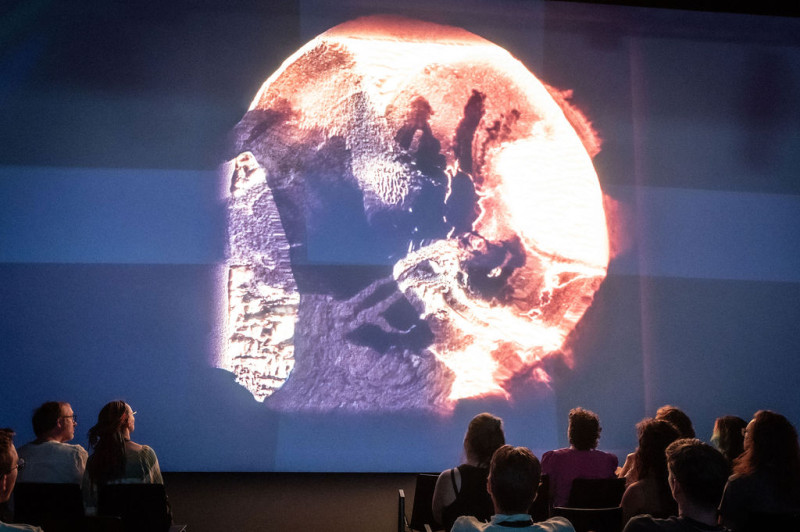
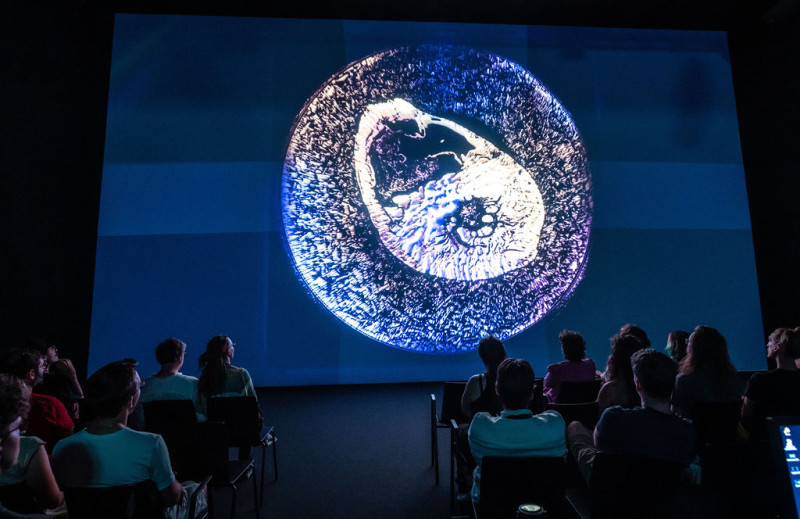
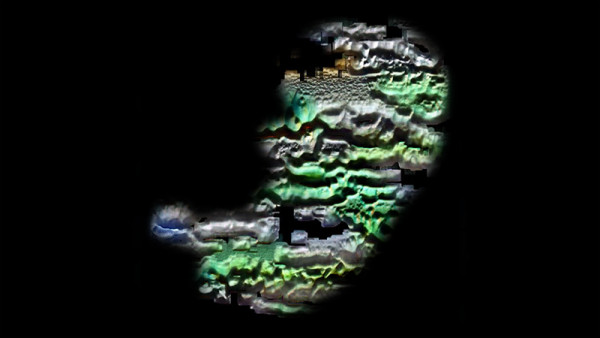
The Latent Force of Living Form explores these analogies through the lens of neural cellular automata, a computational model of morphogenesis. The simulation is trained on a dataset of images depicting both healthy and cancerous human tissue, augmented by visual motifs representative of the structures of power that govern modern human life. These motifs include images from various domains — such as cartography, writing, and mineral extraction — that symbolize the forces shaping our world. In this artwork, each pixel on the screen corresponds to a cell that holds a multidimensional chemical state. The neural cellular automata model learns a set of rules that orchestrate the evolution of these states, leading to a self-organizing phenomenon that reproduces the complexity of the original images. As the simulation unfolds, patterns emerge on the visual plane that reflect the intricate dynamics and latent transformations occurring beneath the surface. These visual patterns, while abstract, highlight the conceptual parallels between biological processes and socio-political ones, inviting us to reflect on the relentless drive for survival and adaptation of these — a drive that can lead to both the emergence and the destruction of the systems that shape our world.
_Błazej Kotowski_
Błazej Kotowski is an artist and researcher born and raised in Poland, currently based in Barcelona. Situated at the intersection of art, sound, technology, software, and politics, his work delves into the transformative impact of new technologies on the human psyche, with a particular focus on the notion of the (cyber) sublime — an aesthetic of digital awe and wonder. Driven by a passion for comprehending the evolving relationship between humanity and technology, Błazej crafts speculative narratives that manifest as sound works, generative systems, installations, and performances. In his research, he is currently pursuing a PhD at the Music Technology Group, where he examines the intricacies of AI’s architectural design.
*Touching Thoughts is an art-science cooperation project the net culture initiative servus.at – Kunst und Kultur im Netz and the JKU’s Medical Faculty (Department of Pathology and Molecular Pathology and Institute of Anatomy and Cell Biology of JKU), that aims at exploring protocols and modes of three-dimensional imaging in the field of digital pathology, and how scientific and medical knowledge and truth are generated through digital technologies.