
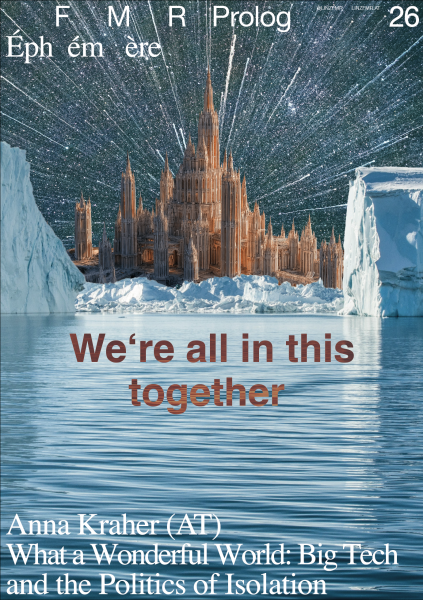
The artist and researcher Anna Kraher (Reseach Lab 2025) was invited to contribute in the last Linz FMR 26 PROLOG. Her Talk "What a Wonderful World: Big Tech and the Politics of Isolation" is based on an ongoing research, initiated during her participation at the Research Lab 2025.
This talk explores how Big Tech’s vision of the future—from privatized cities and space colonization to doomsday bunkers—reflects a growing ‘Politics of Isolation’. These projects signal the tech elite’s departure from a shared common ground: corporate-run territories as retreat from legal and regulatory frameworks, bunkers as escape from ecological limits, and space colonization as detachment from Earth itself. In this worldview, freedom is imagined as an escape from responsibility and the collective.
Yet, these isolationist strategies rely on global systems of labor and environmental extraction. What appears as isolation is, in fact, an exploitative relationship. This echoes right-wing ideologies, that promise belonging by drawing borders and claim common ground where there is exploitation. At its core is a liberal concept of freedom–rooted in property rights, unrestricted mobility, and withdrawal from collective responsibility.
For tech elites, this suggests an escape route from a world in crisis, while the majority are left to confront a collapsing planet. In contrast, the ‘freedom to stay’ requires the preservation of a collectively habitable world, where we have the right to remain present.
<---------------------------------------------------------------------->
Anna Kraher (she/her) is a researcher working at the intersection of critical philosophy, media theory, and the arts. Her academic and artistic practice explores the societal implications of artificial intelligence (AI) and Big Tech, with a particular focus on the interplay between AI ideologies, predictive analytics, and temporalities. She is currently a research assistant in the Ethics and critical theories of AI research group at the University of Osnabrück. She studied Design & Computation, Computer Science, and Gender Studies in Berlin.


